
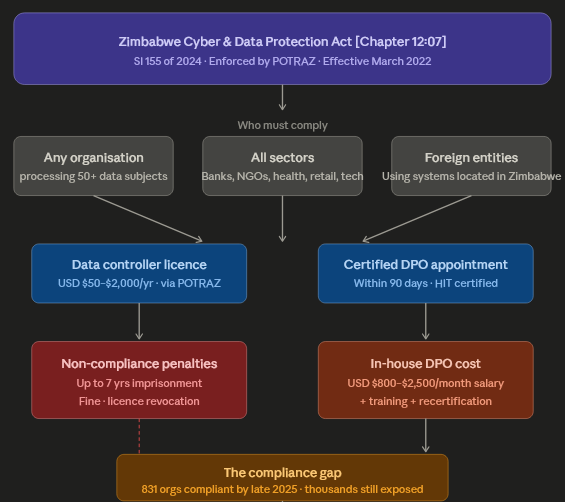
The deadline has passed. Since March 2025, every organisation in Zimbabwe that collects, stores, or processes personal data on 50 or more individuals has been legally required to hold a Data Controller licence from POTRAZ — and to have a certified Data Protection Officer in place.
Most organisations still don’t.
As of late 2025, only 831 organisations had achieved formal compliance with Zimbabwe’s Cyber and Data Protection Act. In a country with thousands of registered businesses, NGOs, financial institutions, healthcare providers, and government agencies — all of whom handle personal data daily — that number is sobering. And POTRAZ has made clear it is paying attention: as recently as March 2026, the regulator publicly raised concern about organisations continuing to process personal data without licences.
The question is not whether enforcement is coming. It is whether your organisation will be ready when it does.
Compliance Is Not the Problem. The Cost of Compliance Is.
Most business leaders we speak to understand the law. They know they need a licence. They know they need a DPO. What stops them from acting is the moment they run the numbers.
Zimbabwe’s SI 155 of 2024 requires that every licensed data controller appoint a qualified, POTRAZ-certified Data Protection Officer. That person must hold relevant qualifications in law, data science, information systems, or a related field. They must complete a certification course at the Harare Institute of Technology. They must operate independently within the organisation, report to senior leadership, and maintain continuous professional development.
When you go to market to hire that person, the salary range is USD $800 to $2,500 per month — before benefits, training costs, and annual recertification fees.
For a large bank or a major telecoms provider, that is a manageable line item. For the mid-sized retail chain, the growing fintech, the NGO managing beneficiary data, the healthcare clinic, the university — it is a serious operational burden. And it is a recurring one, because compliance is not a once-off exercise. The licence renews every 12 months. The DPO must be continuously developed. The risk landscape keeps shifting.
This is where many organisations find themselves stuck: aware of the legal obligation, unable to justify the full cost of meeting it in-house, and quietly hoping the regulator’s attention lands elsewhere.
That is not a strategy. It is exposure.
What Non-Compliance Actually Costs
Let us be direct about what is at stake.
Under the Cyber and Data Protection Act, a data controller who continues to process personal data without a licence is guilty of an offence liable to a fine not exceeding level 11 — approximately USD $1,000 — or imprisonment of up to seven years, or both.
Failing to appoint a DPO carries a separate penalty: a fine of up to USD $400 or up to two years’ imprisonment.
Beyond the penalties, POTRAZ holds the power to conduct audits and investigations, issue corrective orders, and impose ongoing sanctions. If a data breach occurs and you have no DPO, no documented security policies, and no breach response process — the regulatory and reputational consequences compound quickly.
And there is the reputational dimension that no fine can fully capture. In a market where trust is a competitive differentiator — whether you are a fintech competing for wallet share, a hospital managing patient records, or a business tendering for enterprise contracts — your data protection posture is increasingly part of your value proposition.
The Talent Pipeline Is Not Keeping Up With Demand
There is a structural challenge that makes the in-house hiring route even more difficult than the salary figures suggest.
Zimbabwe’s DPO certification programme, run through HIT, is producing graduates — but not at the pace the market needs. The law created demand for certified DPOs almost overnight. The training infrastructure, however developed and respected, is still catching up. Organisations that move quickly to find and retain certified talent have an advantage. Those that wait risk finding the market for qualified DPOs increasingly competitive and expensive.
There is also a retention challenge. A skilled, certified DPO is a marketable professional. Organisations that invest in training a DPO face the real possibility of that individual being recruited away — leaving them back at square one, potentially in breach of their licensing obligations, scrambling to appoint and certify a replacement within the regulatory timeframe.
There Is a Smarter Way
An outsourced DPO service gives your organisation everything the law requires — a qualified, certified, POTRAZ-recognised data protection officer — without the overhead of a full-time executive hire.
At SART Advisory, we provide exactly that.
Our team of certified data protection professionals serves as your organisation’s DPO on a managed service basis. We handle the day-to-day compliance obligations: POTRAZ notifications, processing activity registers, breach response, staff awareness, DPIA reviews for high-risk processing, and ongoing advisory. We give your leadership team a credible, independent point of contact for regulatory matters — and we give your organisation the paper trail that demonstrates commitment to compliance, not just intention.
The result is full legal compliance at a fraction of the cost of an in-house hire. No recruitment risk. No retention anxiety. No gap in coverage when staff turn over.
For organisations that are already licensed but have struggled to fully operationalise their data protection framework — we can step in as a fractional DPO to close the gaps before an audit or incident exposes them.
The Window Is Narrowing
Zimbabwe’s data protection journey is accelerating. POTRAZ has been nominated by SADC to lead data protection capacity building across the entire Southern African region. The regulator is building its enforcement muscle, upskilling its workforce in AI, cybersecurity, and compliance assessment, and producing sector-specific guidelines for government, financial services, healthcare, and more.
This is not a regulator still finding its feet. It is one that is becoming more capable, more confident, and more connected — regionally and internationally.
Organisations that treat compliance as a future problem are running out of future.
Start the Conversation
If your organisation processes personal data on 50 or more individuals — and almost every business in Zimbabwe does — you need to be licensed, you need a DPO, and you need a defensible compliance programme.
SART Advisory can help you get there efficiently, affordably, and with confidence.
Get in touch with our team today to discuss how our outsourced DPO service works and what it would mean for your organisation.
📧 info@sartadvisory.tech